Achievements
Securing Space
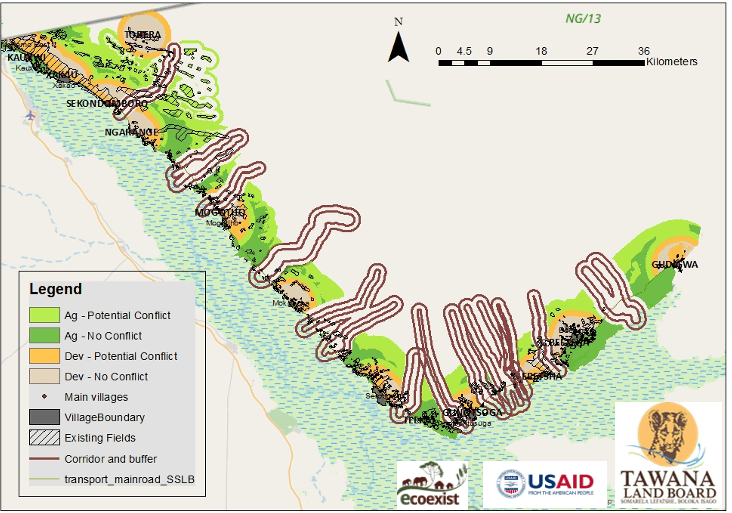
In partnership with the community and Government we have piloted an effort to secure space for elephants by keeping essential time worn movement corridors free from future development and identify good safe farm land for people. Informed land use planning like this is essential to address a root cause of human-elephant conflict – competition for land, water and resources, and find long term solutions for coexistence. The next steps involve facilitating implementation of these plans and ensuring space is secure for both people and elephants.
Learn More +
1. Securing Space
- 13 Elephant corridors demarcated in the eastern Okavango Panhandle.
- 24 Elephant corridors demarcated in the western Okavango Panhandle.
- 26 Elephant corridors identified in the southern Okavango.
- LUCIS mapping completed for 6 Sub land boards.
- 83,000 ha of elephant corridors protected from future arable land conversion in land use planning allocation processes and practice.
- 65,000 ha of good agricultural land identified away from elephant corridors that are being fenced with passive deterrent techniques.
- >500 Cluster field farmers protected from elephants.
- 100 "Elephant Aware Farming" demonstration farmers registered and supported.
Elephant Aware Economy - Improving and Diversifying Livelihoods because of Elephants
We are facilitating private sector support for community-based tourism and other opportunities for people to gain economic benefits from living near elephants – establishing an Elephant Aware Economy. It is important to find ways to improve and diversify livelihoods, this involves increasing benefits from living with live elephants, encouraging people to be safe around elephants, and facilitating elephant themed enterprise development. This will contribute to improved perceptions and stewardship among communities and reduce vulnerability to engage in wildlife crime.
Please visit the Elephant Aware Economy website to find out more
Learn More +
2. Elephant Aware Economy - Improving and Diversifying Livelihoods because of Elephants
- 100 “Elephant Aware Farming” demonstration farmers connected to new value chains.
- 10 new local innovative Elephant Aware enterprises supported e.g. Elephant Dung products, elephant aware agricultural produce, elephant-aware honey, crafts and ‘life with elephants’ tourism start-up enterprises.
- 100 basket weavers producing new elephant designs and reaching international markets.
- 3 “Life With Elephants” tourism enterprises linked with local Safaris market.
- 5 “Life With Elephants” crafts, art, theatre and dance cultural celebrations held.
- 50 Elephant Aware Farmers signed conservation agreements, connected to new markets, and selling certified “elephant Aware” produce to for premium prices.
- Over 120 artists making Elephant Aware craft products.
Managing Conflict
We focus on improving short-term strategies for conflict management by working with and for the government and communities to develop a Community Based Conflict Mitigation approach that incorporates shared responsibility, human-human conflict resolution, and a set of holistic and innovative elephant deterrent techniques.
Learn More +
3. Managing Conflict
- 14 Ecoexist Community Officers working closely as team and active in their villages.
- Integration of activities with Department of Wildlife, Land Board and Ministry of Agriculture.
- Secretariat of the Human Wildlife Coexistence Working Group including 30 stakeholder groups.
- Facilitated establishment of the KAZA Elephant Sub Working Group.
- Over 100 Elephant deterrent workshops held, with over 300 farmers empowered.
- 14 Safety Around Elephant workshops conducted annually.
- 7 Community Chilli Plots developed.
- 6 Cluster field demo elephant deterrent fences, protecting 300 farmers.
- 7 Field guides and booklets produced to create more awareness on how to reduce conflict and foster coexistence between people and elephants.
Elephant Aware Farming
We are building farmer resilience to the effects of elephant crop raiding by improving agricultural techniques, including short cycle crops and conservation agriculture. These efforts are helping to protect food and lives for both people and elephants. Good land use planning is coupled with more effective methods of protecting fields from elephants and encouraging farmers to practice more sustainable, climate smart, or no-till agriculture to improve resilience of farmers and increase food security. We are also creating incentives, which will enable people to farm in this “Elephant Aware” way and strengthen pride and identity in the people living with elephants.
Learn More +
4. Elephant Aware Farming
- 100 “Elephant Aware” demonstration farmers empowered and supported.
- Conservation Agriculture Policy Brief written and considered during policy review.
- Elephant Aware training and equipment for more than 100 farmers.
- Facilitated 7 cluster field constitutions and erected 6 solar electric cluster fences.
- 1 Elephant Aware farmer cooperative established.
- 1 Elephant Aware App developed to monitor Elephant Aware farmers and produce.
- 1 Field Guide on Elephant Aware farming produced.
Understanding the social-ecological landscape
We are continually learning more about elephants and people to fill knowledge gaps and inform policy decisions and change. We have a research program with graduate students focusing on understanding the social and ecological landscape. This involves conducting satellite collaring telemetry studies and population surveys of elephants to record elephant numbers and movements in northern Botswana and the KAZA region, and informing national and regional elephant management strategies.
Learn More +
5. Understanding the social-ecological landscape
- 52 elephants tracked
- 7 Aerial Surveys conducted.
- Over 2000 interviews and questionnaires conducted.
- Cross collaboration formed through the KAZA elephant sub working group to inform policy makers across KAZA.
- 1 Policy brief produced on elephant movement and connectivity across KAZA.
- Multidisciplinary research programme supported 6 PhD and 4 MSc students at 4 different academic institutes (University of Oxford, Texas A&M University, Botswana University of Agriculture and Natural Resources and University of Cape Town) to further our understanding of the social-ecological landscape.
- Multiple peer reviewed scientific and public media publications.
Partnerships
We are proud to have established and facilitated partnerships with so many stakeholders and collaborators across various sectors and institutions in the public and private sectors and civil society. Through partnerships, we have leverage so much progress and success in much of the support and intervention we focus on, from implementing mitigation methods to avoid conflict, to building a landscape approach that involves land allocation process that considers elephant corridors, multi-ministerial government support for interventions and policy change for coexistence, to private sector partnership development in building value chains and supporting elephant aware enterprises and investing in products and services that promote coexistence. See partners.
Sharing knowledge and Ideas
We share the knowledge and lessons learnt we've gained and lessons learnt from our work with as many people as we can.
Ecoexist is a founding member and the secretariat of the Human-Wildlife Coexistence Working Group, which brings people together from Government departments, NGOs, Community Based Organisations, Village leadership, Farmers Associations, Research Institutes, and other stakeholders. This group has the objective “To provide a platform for multisectoral stakeholder dialogue, co-operation and documentation to facilitate appropriate strategies to reducing conflict, promoting co-existence and evaluating success in each.”
We are also a founding member of the KAZA Elephant Sub Working Group (KESWG) which brings together stakeholders (Government representatives, NGOs and researchers) working in elephant conservation and management from the five KAZA countries – Botswana, Namibia, Angola, Zimbabwe and Zambia. Currently 9 NGOs working on elephant research and/or HEC intervention are members of the group.
We conduct numerous workshops and meetings in villages and schools to share knowledge with all members of the community and learn from the people living with elephants. A great way to communicate what we all know about living with elephants is through art, theatre, crafts and film. We also produce awareness materials on topics such as “Safety Around Elephants”, “How to protect your field from elephants?”, “What is “Elephant Aware” Farming”, as well as tackling issues related to wildlife crime.
We pride ourselves in connecting science with on the ground conservation efforts. We therefore publish our work in scientific peer reviewed journals as well as public media outlets.
If you would like to learn more, we’d love to hear from you. Please contact us at info@ecoexisttrust.org